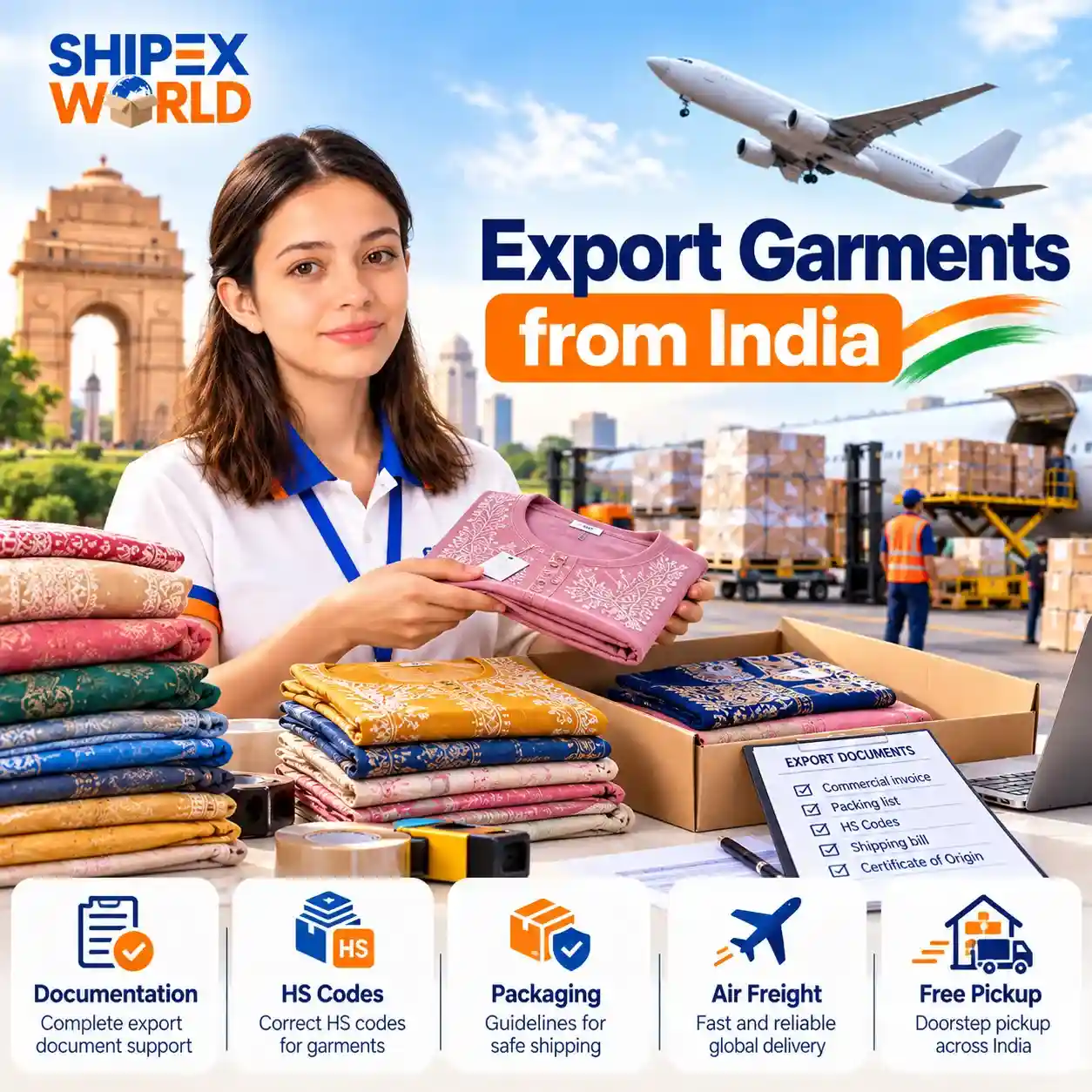
Want to export clothes from India commercially? Learn the IEC, GST/LUT, shipping bill, HS codes, RoSCTL benefits and air freight steps in this guide.
Why it’s a good year to start exporting garments
India is one of the world’s biggest garment suppliers, and this year is good to start exporting. Duty-free access to the UK, a courier route with no value cap, and continued tax rebates for apparel exporters have made things easier for small and mid-sized sellers.
But a first shipment can still feel confusing. Which registrations do you need? What is an HS code and why does everyone keep asking for it? Should you go by air freight or courier? This guide walks through it in plain steps, from registration to delivery.
Step 1: Get your basic export registrations in place
Before you pack a single carton, you need these:
- Import Export Code (IEC): A 10-digit code from DGFT, mandatory for commercial exports. Without it, customs will not clear your shipment.
- GST registration: Needed to export formally and to claim tax benefits.
- Current bank account with an AD code: Your bank gives you an Authorised Dealer code, which you register with customs on the ICEGATE portal. This is how your export proceeds are tracked.
- RCMC (optional but useful): A Registration-cum-Membership Certificate from the Apparel Export Promotion Council (AEPC). It helps with trade fairs, buyer leads and scheme benefits.
- Digital signature certificate (DSC): Required for filing documents online.
Tip: Open your export bank account early, since AD code registration can take a few days.
Step 2: Understand GST on exports (LUT vs IGST)
Exports are zero-rated under GST, which means you don’t bear GST on goods sent abroad. You have two options:
- Export under a Letter of Undertaking (LUT): You don’t pay IGST at all. This is the easier route for most small exporters, and the LUT is filed free on the GST portal each financial year.
- Export with IGST payment: You pay IGST on the shipment and claim a refund later. This ties up cash, so it suits fewer businesses.
Talk to your CA about which one fits your cash flow.
Step 3: Find the right HS code for your garments
An HS (Harmonised System) code is a number that tells customs exactly what you’re shipping. It decides duty rates abroad, your export incentives, and which rules apply. Getting it wrong can lead to delays, wrong duty or penalties.
The first 6 digits are international. India uses 8 digits (ITC-HS) for exports, and many importing countries add more digits for their own tariff.
The big split to remember:
- Chapter 61: Knitted or crocheted apparel (T-shirts, sweaters, leggings)
- Chapter 62: Woven (not knitted) apparel (shirts, trousers, dresses)
- Chapter 63: Made-ups such as bed linen, curtains and towels
| Product | Typical HS heading |
|---|---|
| Men’s or boys’ knitted shirts | 6105 |
| Women’s knitted blouses and tops | 6106 |
| T-shirts, singlets, vests (knitted) | 6109 |
| Sweaters, pullovers, hoodies (knitted) | 6110 |
| Men’s suits, jackets, trousers (woven) | 6203 |
| Women’s suits, dresses, skirts, trousers (woven) | 6204 |
| Men’s shirts (woven) | 6205 |
| Women’s blouses and shirts (woven) | 6206 |
| Bed linen | 6302 |
These are 4-digit headings only. Fabric, fibre, gender and style can change the full code, so confirm your exact 8-digit code before filing. Your CHA or freight partner can help, and so can the Indian customs tariff and the importing country’s tariff database.
Step 4: Know the documents you’ll need
For a commercial garment shipment, keep these ready:
- Commercial invoice: Seller, buyer, itemised description, quantity, unit price, HS code, Incoterms and total value
- Packing list: Number of cartons, pieces per carton, net and gross weight, carton dimensions
- Shipping bill: The main customs export document, filed electronically through ICEGATE
- Airway bill (AWB): The transport document issued by the airline or freight forwarder
- Certificate of origin or origin declaration: Needed if the buyer wants lower duty under a trade agreement
- Export contract or purchase order
- IEC, GST and LUT copies
- Test reports or compliance documents, if the buyer requires them (for example for dyes or chemicals)
Descriptions matter. “Garments” is too vague, so write “Women’s cotton woven dresses, 100% cotton, HS 6204” with fibre content.
Step 5: Claim your export incentives
Apparel exporters in India can benefit from:
- RoSCTL: The Rebate of State and Central Taxes and Levies scheme refunds embedded state and central taxes on garments and made-ups. It has been extended for apparel and made-ups until December 31, 2026, so check the current status when you file.
- Duty drawback: Refunds customs duty paid on imported inputs used in your export products.
- RoDTEP: Covers other textile products that fall outside RoSCTL, so it’s relevant for items beyond Chapters 61, 62 and 63.
Rates differ by product, and schemes get extended or revised from time to time. Mention your claim on the shipping bill and confirm current rates with your CHA.
Step 6: Use trade agreements to help your buyer
Duty is a major factor when buyers choose a supplier. If your buyer is in the UK, Indian-made apparel now gets zero duty access under the India-UK trade agreement, which has been in force since 15 July 2026.
But the preference is not automatic. Goods need to meet the origin rules, and you need a proof of origin. For UK imports, acceptable proof can be an origin declaration completed by the exporter or producer, a certificate of origin from an authorised issuing agency, or the importer’s own knowledge. Keep supporting records, because exporters can be asked to prove origin later.
A “Made in India” label alone is not enough proof. Keep your yarn, fabric and stitching records organised.
Other agreements, such as the India-UAE CEPA and India-Australia ECTA, work in a similar way. Always check the exact rules for your product and destination.
Step 7: Choose your shipping route
- Courier (express): Best for samples, small orders and quick turnarounds. A key change in 2026: the ₹10 lakh limit on courier exports was withdrawn from April 1, 2026, so high-value consignments no longer have to switch to cargo just because of value. Courier is door to door, with customs handled by the carrier.
- Air freight: Better for larger, regular orders. Cost per kg is lower than courier at higher weights, though you’ll deal with airport-to-airport handling, a freight forwarder and a customs house agent (CHA). Transit is usually a few days between major airports, plus handling time on both ends.
- Sea freight: Cheapest for bulk volume, but it can take weeks. It suits large seasonal orders more than urgent replenishment.
A simple rule of thumb: samples and orders up to a few hundred kg usually go by courier, regular mid-size lots by air freight, and full container orders by sea.
How air freight charges work for garments
Air cargo is billed on chargeable weight, which is the higher of actual weight and volumetric weight. For air freight, volumetric weight is usually calculated as length x width x height (in cm) divided by 6000. Courier often uses 5000, so the same box can price differently depending on the service.
Garments are light but bulky, so volume often decides the price. Compress and pack neatly:
- Use poly bags to cut bulk and protect from moisture
- Pack in standard, strong export cartons of consistent size
- Avoid half-empty cartons
- For hanging garments, ask about Garments on Hangers (GOH) options, which cost more but protect premium pieces from creasing
Other charges to expect: fuel and security surcharges, airport handling, customs clearance fees and destination-side costs. Ask for an all-in quote with the Incoterm clearly stated (FOB, CIF, DAP or DDP).
Step 8: Pack and label for export
- Wash-test, iron and quality check items before packing
- Fold flat, and use polybags with a suffocation warning where required
- Use 5-ply corrugated cartons with strong tape
- Mark cartons with carton number, quantity, size ratio, net and gross weight, and “Made in India”
- Attach compliant care and fibre content labels, since many countries have specific rules
- Keep a carton-wise packing list, and number cartons clearly
Step 9: The export process from start to finish
- Confirm the order, price and Incoterms with your buyer
- Check the HS code and incentives
- Produce, inspect and pack the goods
- Prepare the invoice, packing list and origin documents
- Book your airline or courier through a freight partner
- File the shipping bill on ICEGATE through your CHA or courier
- Hand over the cargo for customs examination and receive the Let Export Order
- Cargo is loaded and the airway bill is issued
- Track the shipment and share documents with the buyer
- Receive payment through your bank, and collect your bank realisation certificate for records and incentive claims
Common mistakes new garment exporters make
- Using the wrong HS code or a vague product description
- Mixing knitted and woven goods under one heading
- Ignoring volumetric weight and getting a surprise bill
- Not collecting proof of origin when the buyer wants a duty benefit
- Under-valuing samples to save on charges, since this can create customs trouble
- Skipping labelling rules in the destination country
- Missing the payment realisation timeline and bank paperwork
How Shipex World helps garment exporters
We handle commercial garment shipments from Delhi NCR to 180+ countries through DHL, FedEx, Aramex and UPS, with same day pickup, documentation guidance, customs support and live tracking. For bigger or recurring orders, we’ll help you compare courier and air freight options so you pick what fits your volume and timeline.
Planning to export garments? Get a free quote on WhatsApp, or call +91 8448427078.